
Knowledge Without a Knower
How Lacan’s "University Discourse" explains why AI doesn't give answers, it only gives data

When I was younger, I remember hearing about an incredible website called Ask Jeeves where you could find out almost anything. Long before “googling” became a verb—and back when AI was still mostly associated with the Terminator—computers and the internet began to transform our relationship with knowledge. Finding answers went from a process of reading books and visiting libraries to receiving instant responses from quick searches. LLMs are another giant step in that same direction.
Search engines and Wikipedia were headaches for high school history teachers trying to convince impatient students that diligent research had value, but they pale in comparison to what LLMs have done to our relationship with knowledge. Traditionally, knowledge required someone to produce it—a scientist, an expert, a tradition—and somewhere to dispense it: a book, a class, or a symposium. Access was as big an issue as creation. But now our machines won't stop talking. An LLM cannot run out of words. It is knowledge without a knower, endlessly produced, with no author required to ground it.

It Is Known
From the perspective of the discourses we’ve been exploring, LLMs respond to users in what Lacan would call the university discourse. Structurally, this means that knowledge itself takes the agent position. The discourse speaks not from I know but from it is known—the given understanding, what has already been established or accepted. That knowledge is addressed to the person’s desire, to whatever they’re pressing for. So when I ask Claude a question, it will always respond from the position of what has been established, in an attempt to speak to my desire. But the fascinating insight from this discourse is that the result is not satisfaction but a greater split. The more I learn about something, the less certain I become.
Lacan used what he called “mathemes” to illustrate his structures. He found that algebraic notation helped avoid the imaginary associations we bring to words and offered a more direct way of transmitting his theory—though they make it far harder to follow and remember. Here are some quick definitions:
S1 — the master signifier; the organizing authority that anchors a discourse
S2 — knowledge; the accumulated system of meaning organized by S1
a — object a; the object cause of desire, the remainder that keeps us wanting
$ — the split subject; the divided human speaker, incomplete and never fully in control of their own meaning
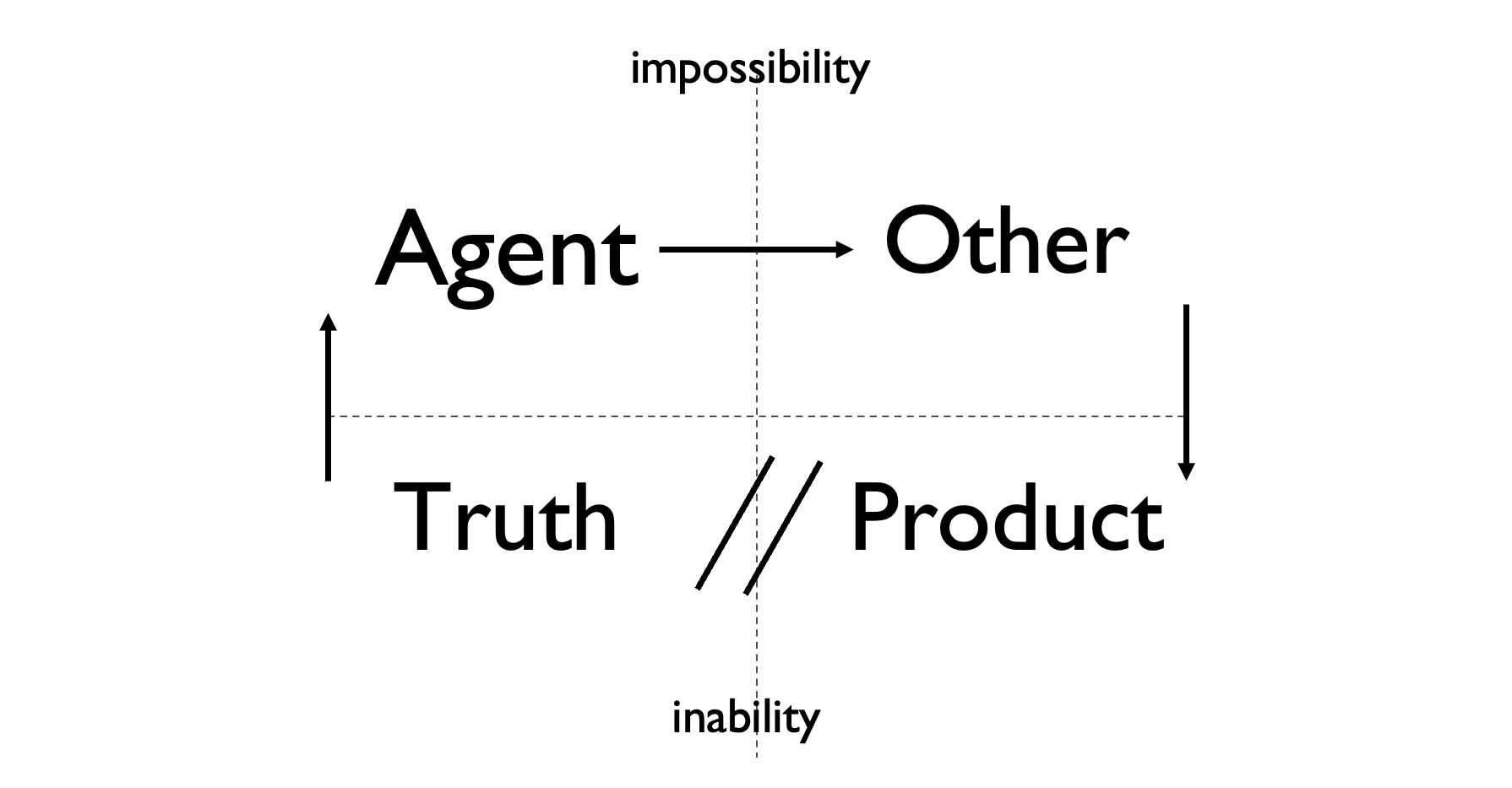
As an educator I see this every year when I teach a clinical skills class to counseling students preparing for their internship. No matter how many interventions or techniques they learn, they do not feel prepared. The imposter syndrome looms as the gap between the knowledge I can offer and the inadequacy they feel refuses to close; and that’s not simply a failure of the curriculum. The gap is structural, not informational. I like to remind students that experience is what you get right after you needed it. There is no amount of learning that will satisfy the imposter syndrome, because the split the university discourse produces is the point, not the problem.

The structure of the discourse helps explain this, because given knowledge is always resting on something. It is known requires a guarantor: a system, an expert, a tradition that underwrites the claim. And this is precisely what must stay hidden in this discourse. Knowledge presents itself as self-grounding, but something is always doing the authorizing work behind the scenes. Lacan called this the master signifier: the S1 that organizes everything the discourse produces while remaining concealed within it. A “dead master” anchors the whole enterprise—Freud behind psychoanalysis, the founding text behind the tradition, peer review behind the scientific consensus. The authority is invoked but no longer present to be questioned directly. Freud is not available for cross-examination. The founding text cannot defend itself.
But the tradition that carries that authority, the institution that invokes it, the methodology built in its wake, remain open to challenge. The university discourse tends to protect its hidden master. Knowledge speaks confidently precisely so that you never have to ask what is organizing it. What kept the academy honest, at its best, was not the university discourse itself but the hysteric's refusal to let it settle. The student or scholar who kept asking but who says so? pressed past the knowledge toward the authority behind it, exposed the cracks, and advanced the discipline. That pressure was possible because the knowledge was held and transmitted by living subjects who themselves lacked, who could be pressed until something gave way. The university discourse and the hysteric's challenge needed each other.
Knowledge Without Lack
Traditionally, this accountability mattered because it allowed for both knowledge dissemination and genuine inquiry. At its best, the academy trained students in what was known, but the inadequacy of that very knowledge was what pushed those students to keep asking questions and advance their disciplines. I find much of what Freud and Lacan wrote to be incredibly helpful, and yet my continued dissatisfaction with psychoanalytic theory is precisely what keeps me writing, thinking, and researching. The split produced by the university discourse can be generative—but only when there is something behind the knowledge that can be pressed, challenged, and held to account.
So when Claude or ChatGPT answer our questions, they do so from within the university discourse, speaking from the position of established knowledge. This might seem to contradict what I argued in the last essay, that we approach LLMs hysterically, installing them as the one who knows. But the two are not in conflict. The human addresses a fantasized master. What responds is not a master but pure S2, knowledge without a subject, speaking from the only position the LLM can occupy. We address a subject and receive an output. The fantasy and the structure never align.
A crucial difference exists between an LLM and the instructors or experts who traditionally occupied that position. Those speakers were subjects. They had been initiated into language, which means they carried the lack, desire, and uncertainty that made their relationship to knowledge honest. An LLM has none of that. It has no unconscious, no desire, no experience of not knowing. It cannot fully occupy the agent position in any structural sense. What happens instead is that our fantasy installs a subject where there isn't one. We experience the output as if someone were behind it. The knowledge keeps speaking, but the subject we imagine is not there.
There is no subject behind the knowledge whose self-awareness would introduce genuine uncertainty, whose confrontation with their own limits would make the knowledge more honest. A human expert who becomes conscious of their blind spots is changed by that confrontation. Their limitations are generative.
Harry Frankfurt's concept of bullshit is useful here, though not quite in the way we might expect. Frankfurt's bullshitter isn't lying, they are simply indifferent to the question of truth altogether. The LLM is not exactly a bullshitter in Frankfurt's sense, but it shares something important with that structure. When an LLM expresses uncertainty it is producing a trained output, not a subject confronting its own lack. The hedge is performed rather than felt. There is no one behind the words who actually doesn't know. And unlike the academy's knowledge structures, which could be pressed until something gave way, the LLM's output has no subject behind it capable of being pressed. You cannot argue with the weights. There is no master to expose—not even the one the hysteric's address tried to install. What organizes the output cannot be questioned in any meaningful sense at all.
Only One Position
This is what makes the LLM’s position in the university discourse so unusual. Traditional educators were themselves split subjects, marked by their own lack and uncertainty, using a discipline or method to pursue their own questions, forming students not just by transmitting knowledge but by modeling a living relationship to it. Their inadequacy was visible, and that visibility was part of what made the encounter generative. The best teachers didn’t just share what was known. They made their own not-knowing present in the room.
An LLM cannot do that. Without constitutive lack, without division, it has no relationship to the limits of its own knowledge. It speaks from the given without any orientation toward what the given cannot reach. And this has consequences not just for the knowledge it produces but for what it cannot do structurally.
Unlike LLMs, split subjects don't stay in one discourse. In the academy, knowledge moved. The hysteric questioned the master, who produced more knowledge that didn't satisfy, which generated new hypotheses, new inquiry, new dissatisfaction. Teachers formed students in relationship to knowledge by allowing their own uncertainty to move students toward curiosity and their own desire. The discourse shifted and failed productively.
An LLM is structurally confined to one position. It cannot fail into the hysteric’s challenge or relinquish into something more open. It can only ever speak from the position of knowledge, endlessly producing more, speaking to desire without ever being shaped by it. It gives us more and more of what is known, but it has no constitutive division that would help us know what to do with it.
In short, it gives us knowledge without wisdom. I have previously written about what that distinction means and why it matters. For now it is enough to say this: wisdom, in the tradition that runs from Socrates to Lacan, is not more knowledge. It is knowledge that knows its own limits. And that requires lack.
What would it mean for an encounter to return us to our own desire and confront our lack rather than attempt to fill it?
📚 Works Cited & Suggested Reading
Frankfurt, Harry G. On Bullshit. Princeton, NJ: Princeton University Press, 2005.
Fink, Bruce. A Clinical Introduction to Lacanian Psychoanalysis: Theory and Technique. Cambridge, MA: Harvard University Press, 1997.
Fink, Bruce. The Lacanian Subject: Between Language and Jouissance. Princeton, NJ: Princeton University Press, 1995.
Lacan, Jacques. The Seminar of Jacques Lacan, Book XVII: The Other Side of Psychoanalysis. Edited by Jacques-Alain Miller. Translated by Russell Grigg. New York: W.W. Norton, 2007.
McGowan, Todd. Enjoying What We Don’t Have: The Political Project of Psychoanalysis. Lincoln: University of Nebraska Press, 2013.
Postman, Neil. Amusing Ourselves to Death: Public Discourse in the Age of Show Business. New York: Viking Penguin, 1985.
Verhaeghe, Paul. “From Impossibility to Inability: Lacan’s Theory on the Four Discourses.” In Beyond Gender: From Subject to Drive. New York: Other Press, 2001.
Žižek, Slavoj. The Sublime Object of Ideology. London: Verso, 1989.